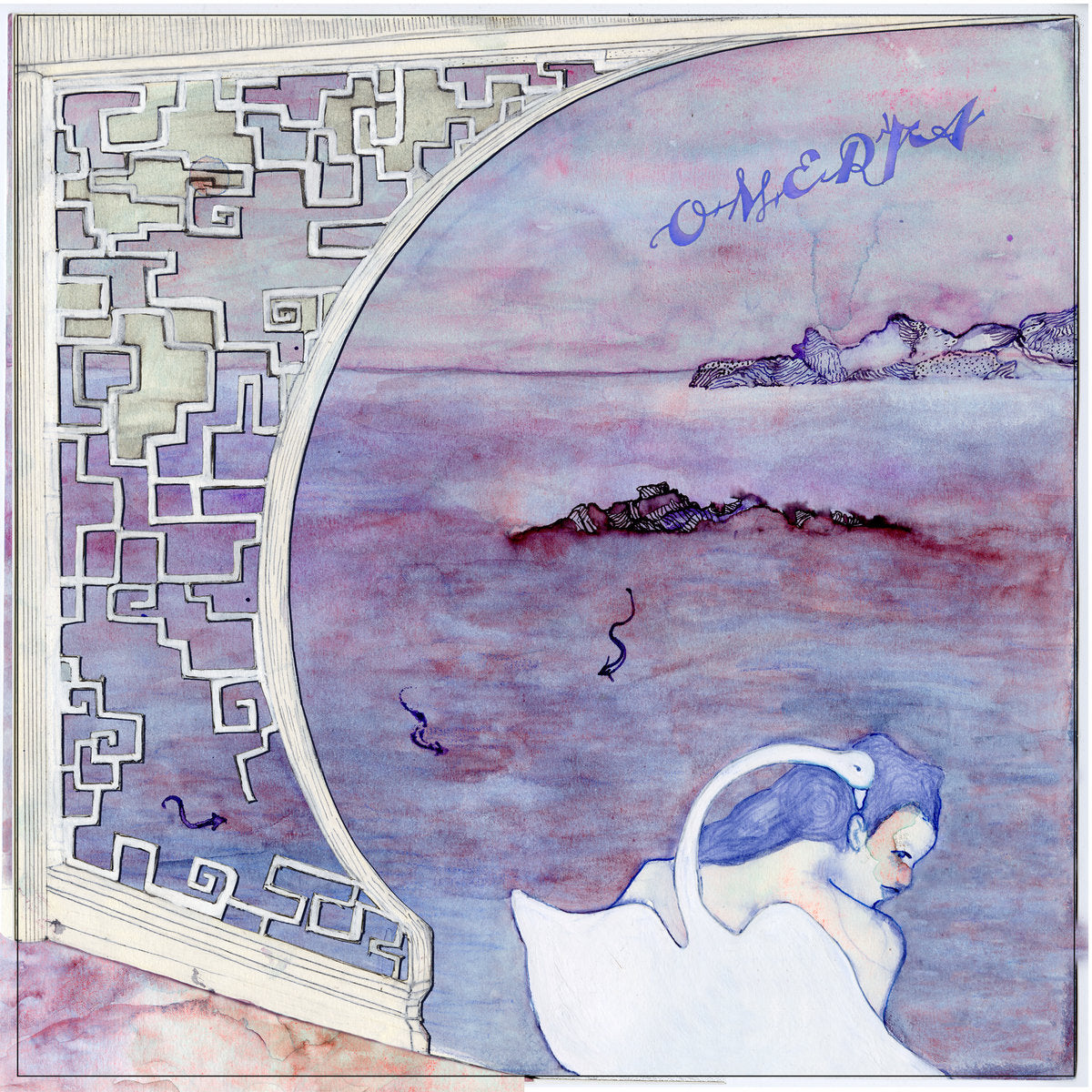

Omertà - Âmes Bleues
Couldn't load pickup availability
Omertà
Âmes Bleues
Carton Records/Standard In-Fi/Zamzamrec
France, 2026
LP
For me, Omertà's last record, Collection Particulière, is one of the finest of the decade so far. Tipped off by the enthusiasm of Time Is Away—"Moments in love" features on their amazing Searchlight Moonbeam comp—I was too late for the first pressing but just in time for the repress. It’s a record that seems to entrance whoever comes across it, a mesmeric set of midnight psych jams anchored by Florence Giroud’s intoned French vocals.
That reputation sets a high bar for their follow-up, Âmes Bleues, but the positive buzz doesn’t seem to have gotten to them. Rather than going bigger, they’ve gone deeper, unspooling dreamlike, watery grooves laced with Giroud’s evocative spoken word (not that I could translate for you).
After the smoke-gathering instrumental intro “Intermède,” “Bleuité” sets the scene for the rest of the record: sinuous guitar lines courtesy of Pierre Bujeau (Megabasse, Tanz Mein Herz), anchored by a heart-thump rhythm section and chiming micro-details. All in all, the record is a grower in the best way, a welcoming but elusive landscape that shifts like mist, and just as patient.
FROM THE LABEL:
Without premeditation nor haste, Omertà re-emerges with its third album, Âmes Bleues (Blue Souls), gracefully deepening its own unique furrow, between lyrically rich songs and singular harmonic explorations.
After ambling through the Corsican air currents and immersing itself in smoke, Omertà continues to unfold its geographical and sensory music, seemingly finding its reach in the suspension inherent in the subtle tension it produces.
The group expands its sonic palette with soothing and psychedelic harmonic sequences, summoning the infinitely poetic through fluid, repetitive motifs transmogrified into songs.
Omertà blurs boundaries, drawing inspiration from everything from jazz to 1970s free rock, to pastoral music, gleaning the freedom of expression of the poet Ingebord Bachmann, for whom ‘anyone who falls has wings’. Âmes Bleues defies conventional interpretation, opting instead for the radical impulse of a journey into Romanticism.
This latest album invites us to transcend, to observe the world in its purest form, from the height of church steeples or simply to contemplate a sky that already contains everything.
Share